

Our websites are SO important to our businesses and organizations.
In many ways, it’s the most important marketing asset we own.
It’s the one place online that you have total control over, and when used properly it can become a consistent lead generator for your business.
At some point, you’re going to start wondering if it’s time for a website redesign.
But how do you determine that?
Because let’s be honest. A redesign takes time, money, and effort. Most of us are already busy enough as it is.
We don’t want to spend resources on something that isn’t necessary.
This article will give you 10 points for consideration.
As you read through them, or even just skim them, write down the ones that cause you to go:
“Ugh… that’s my site right now.”
That reaction is actually very useful because it serves as a great filter for prioritizing improvements in your website.
When your brain says “Ugh”, it usually means something needs attention.
So pay attention to how often that reaction occurs as you read this list. The number of times you feel it can help you determine whether a website redesign should move higher on your priority list.
(1)You aren’t proud of it anymore
You and your team should feel proud of your website.
You should want to send people there to learn more about what you do and what you don’t do.
Remember, your website is essentially your 24/7 sales page.
If you find yourself hesitating at all to tell people to visit it, that’s a warning sign.
Instead of sending people to your website, you might find yourself data dumping information when you talk to them. You explain everything manually instead of letting your website help carry that message, saving you time and energy.
And if you are not proud of your website, visitors may sense that same hesitation.
They may feel unsure about reaching out.
Hesitation leads to doubt which leads to inaction.
And that inaction will cause people to not want to take the next step with you.
(2) It doesn’t reflect your brand
Your brand and identity evolve over time.
If your company is growing, improving services, or simply trying to stay relevant, your messaging and positioning likely change as well.
Websites often fall behind those changes.
The longer you go without updating your website, the wider the gap becomes between who you are today and what your website says about you.
For example, here at Pro Website Creators we are doing more and more work with AI tools and automation.
We have written some blog posts about it and posted videos of us doing experiments and going through the latest news.
But if we are honest, we probably do not emphasize it enough across the site yet.
That gap between reality and representation is one of the clearest signals that it may be time for a redesign.
(3) It stopped generating leads
If your website is not generating leads, or at least supporting lead generation, something is wrong.
That does not necessarily mean the website itself is broken.
It could be your SEO.
It could be your advertising strategy.
It could be your messaging.
It could be your conversion pathways.
But regardless of where leads originate, most people will still visit your website before doing business with you.
They want to learn more about you, your team, and what you do.
They want to confirm you are legitimate.
And they want an easy way to raise their hand and say:
“I’m interested.”
Your website must give them that opportunity.
We have written extensively about ways your website can generate leads. You can read more here:
https://prowebsitecreators.com/how-to-use-your-website-to-save-hours-each-week/
If your business relies heavily on referrals, this becomes even more important.
Referral prospects almost always check your website before contacting you.
(4) It’s more than two years old
If it has been more than two years since your last redesign, it is worth taking a serious look at your website.
At a minimum, it probably needs to be spruced up.
That might mean adding new photos, publishing new articles, updating services, or refreshing messaging.
To be clear, two years is not a magic number.
Some websites remain effective longer than that.
But reaching that point should at least trigger a calendar reminder to review your site carefully and determine whether a redesign or refresh makes sense.
Because likely, as we’ve stated, your website has drifted from what you do and/or who you are.
(5) Your competitors look better online than you do
This one is very important.
Many prospects are looking for reasons not to choose your business.
If your competitors’ websites look stronger, more modern, or more trustworthy than yours, that can easily influence the decision.
Your website does not necessarily need to be better than every competitor.
But it should at least keep you competitive in your space.
If it does not, prospects can easily move on to someone else.
If you want to understand this better, read our article on Competitive Set Analysis:
https://prowebsitecreators.com/competitive-set-analysis-why-your-competitors-are-winning-online/
Once you determine how competitors are positioning themselves online, make sure your website clearly reflects how you are better or different.
(6) It isn’t mobile friendly
Mobile traffic is a large part of the traffic your website receives.
However, for many businesses, mobile traffic now exceeds desktop traffic.
For example, looking at the data from one of our amazing clients, their website clicks show that a large portion of visitors arrive using their mobile phones, and that the number exceeds desktop.
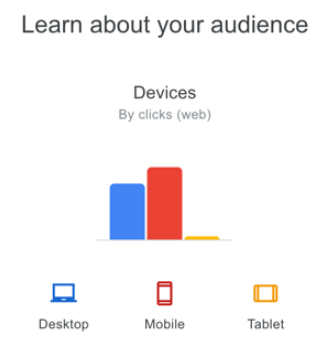
Therefore, your website must be optimized for both desktop and mobile users.
Visitors should be able to discover you easily, learn about you quickly, and contact you with minimal friction.
Some mobile improvements include:
- Click to call buttons
- Simplified navigation
- Optimized images
- Clear contact options
The best test is simple and something you can do very quickly!
Open your website on your phone and explore it as if you were one of your ideal clients.
You will quickly discover what works and what needs improvement.
Better yet, record yourself doing it, making comments, then send it to your web professional to make the updates and/or give you a quote!
(7) It loads slowly
Website speed matters.
Not necessarily only because of SEO, but because of user experience and conversions.
People are impatient online, especially on mobile devices.
If your website takes too long to load, visitors will simply leave.
We discuss this further in our article on the Top 5 Ways Your Website Can Hurt Your Business:
https://prowebsitecreators.com/website-mistakes-that-hurt-business/
Your site does not have to be lightning fast.
But visitors should see something meaningful quickly.
Even small improvements in load time can reduce bounce rates and increase engagement.
(8) It's Hard to Update
You need to be updating your site on a regular basis.
New articles, infographics, podcasts, updates on your services, etc., all need to go on your site. Google likes updated sites.
So it shouldn’t be hard to update.
Now there are three ways to get your site updated:
- you do it yourself.
- you have someone on your team do it.
- you have a service that does it for you, with you providing the content.
At Pro Website Creators, we do many updates for clients so they don’t have to worry about it. That’s a great way to go.
However, you should be able to make some updates yourself when it comes to most of the content.
(9) Your messaging is unclear
Within just a few seconds of visiting your website, someone should understand what you do.
If they cannot figure that out quickly, you are likely losing potential business.
There is an old marketing principle that still applies today:
Confused minds don’t buy.
Your website should make it easy for visitors to understand what you do, see how you help, contact you easily, and learn what your organization stands for.
Here is a simple test.
Think about the main problem your ideal client has.
Now go to your homepage and ask yourself:
Do I clearly see that problem or the solution immediately?
For example, imagine someone searching for help with headaches.
When they land on a website, they might immediately see something like:
“Does your head constantly bother you?”
or
“We help people eliminate persistent headaches with natural herbs.”
In either case, the visitor instantly knows they are in the right place.
That clarity encourages them to continue reading.
Your messaging should work the same way.
(10) It isn’t helping grow your business
Ultimately, your website should help grow your business.
If it is not contributing to that goal, then it probably needs improvement in several of the ways we have already discussed.
A website should help you:
- Attract potential customers
- Educate prospects
- Build trust
- Generate opportunities
If it is not doing those things, it is time to improve it.
There is also another important piece to consider.
You need trackable ways to measure whether your website is helping your business grow.
Without analytics, lead tracking, or measurable conversion points, you will not know whether improvements are actually making a difference.
So how did you do?
For our own website here at Pro Website Creators, the “Ugh” response happened three times!
Which means it’s probably time for us to update our own website too.
And that is actually a healthy exercise for any organization.
Because the goal is not perfection.
The goal is making sure your website continues to serve your business well and help it grow.
If you read through this list and found yourself saying “Ugh” more than once, it may be time to take a serious look at your website and consider what improvements could help it better support your business.