


Competitive set analysis starts with a simple truth: your competitors are not the enemy, they are data showing you what is working, what is expected, and where the bar is right now.
They’re showing you what’s working, what’s expected, and where the bar is right now.
Why are your competitors winning online?
The simple answer is this:
They’re actually using their website and social media on purpose.
They use their online presence to:
- Create awareness
- Serve their audience
- Build trust
- Generate leads
In other words, they care about their website.
And if you’re ignoring the most important digital asset you own, your website, you’re almost certainly falling behind.
Your website isn’t just a brochure.
It’s a sales tool.
A credibility builder.
A time-saver.
If you’re not sure how your website can actually help your business in practical ways, I recommend reading a few of our recent articles, including Top 6 Ways Your Website Can Help Your Business and How to Use Your Website to Save Hours Each Week.
But let’s zoom out a bit.
Because this question goes beyond websites and social media.
So… why are your competitors really winning?
In almost every case, it’s one or more of the following (this isn’t exhaustive, but it’s common):
- Lower pricing or a lower cost of doing business
- A better or more clearly positioned product or service
- Faster turnaround time
- Lower client acquisition costs
- Premium pricing with premium positioning
- A stronger money model than yours (if you want our free book on this by Alex Hormozi, just let us know)
- Better use of a team instead of doing everything themselves
- Smarter use of AI to move faster, serve better, or reduce friction, including chatbots and automation
- Consistent generation of qualified leads
- A clear niche they are maximizing
- Better search visibility, including local SEO
In fact, one of the biggest differences we see is not how many leads competitors get, but how qualified those leads are.
A lot of businesses think they have a lead problem when they really have a clarity problem.
Your website should be doing two important things before a prospect ever talks to you:
- Answering common questions up front
- Setting expectations clearly
Those are the first two ways we talk about in How to Use Your Website to Save Hours Each Week.
When your website does this well, you don’t just get more inquiries, you get better ones.
Doing one of the most valuable strategic exercises, a Competitive Set Analysis, will really help you here.
Perform a Competitive Set Analysis for Your Business
A Competitive Set Analysis, also known as a Competitive Gap Analysis, helps you clearly answer several questions:
What are they doing that we’re not?
For how much are they doing it?
Are we doing things they aren’t?
You’ll compare things like:
- Pricing
- Features and benefits
- Delivery time
- Quality
- Customer experience and satisfaction
- Visibility and lead generation
- And anything else that truly matters in your industry
The goal is not to copy your competitors.
The goal is to serve your clients better, strengthen what makes you different, and reduce areas where you’re unnecessarily weak.
In other words, help to get more yeses and fewer nos on the road to helping create stronger and better clients.
And it helps bolster the “why” behind what you do, as the strongest and most powerful “whys” almost always come from serving others well.
This doesn’t have to be hard anymore
Doing a Competitive Set Analysis, whether for the first time or as a yearly exercise, does not have to be complicated.
It’s easier than ever:
- AI tools and deep research modes can do a lot of the heavy lifting
- You can directly ask your best clients why they chose you
- You can ask what they value most
- And how you could serve them better in the next year
So at least send an email.
Better yet, pick up the phone.
If this is hitting a little close to home, that’s normal.
Most business owners don’t lose or get behind because they’re lazy or careless. They lose because they’re busy and reacting instead of stepping back and looking at the whole picture.
The challenge today isn’t getting information.
It’s doing something with it.
Because once you have insights, it can feel overwhelming.
So here’s a simple filter we use.
A simple decision filter that works
When you start collecting ideas from client conversations and competitive research, run them through these four questions:
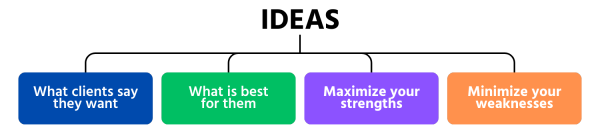
If you consistently apply this filter, you’ll have a solid roadmap instead of a long list of disconnected ideas.
Now you don’t need to act on every insight you uncover - that will lead to overwhelm, fatigue, and eventually burnout.
You just need to act on the ideas that pass this filter with some common business sense.
(1) What your clients say they want
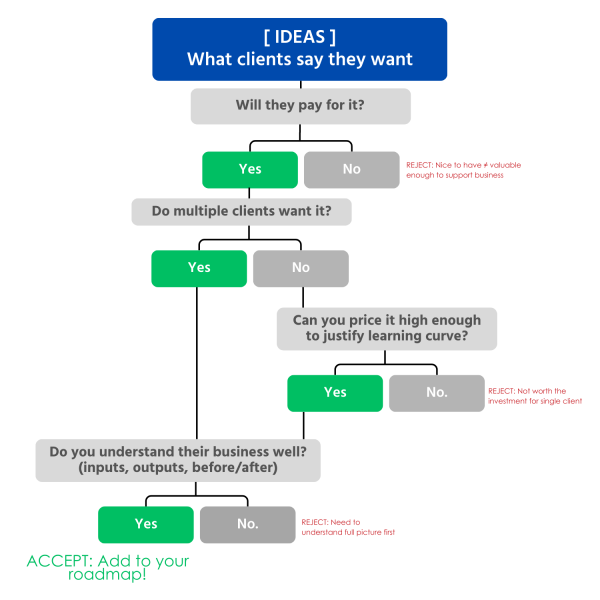
Listening to your current clients usually gives you clear direction.
You already have trust, and they know you deliver.
That makes conversations easier and decisions faster.
But there are two caveats.
Caveat #1
They have to be willing to pay for it.
Something can be nice to have without being valuable enough to support your business.
Caveat #2
If only one client wants it, you need to price it high enough to justify the learning curve.
Recently, we enabled French translation for a client because they served a French-speaking community. Another client likely needed it too, so we went ahead and implemented it.
The solution worked well.
But in hindsight, we would have chosen a different approach that was less resource-intensive to build and maintain.
So before talking with clients, make sure you understand their business well enough to see the full picture.
Understand their
- Inputs.
- Outputs.
- Before and After.
For example, if you’re an executive coach:
- What causes someone to need you in the first place?
- What can you offer before they work with you?
- What should exist after they’ve worked with you?
You don’t need to provide every solution yourself.
But you should be thinking in terms of solutions.
(2) What is best for your clients
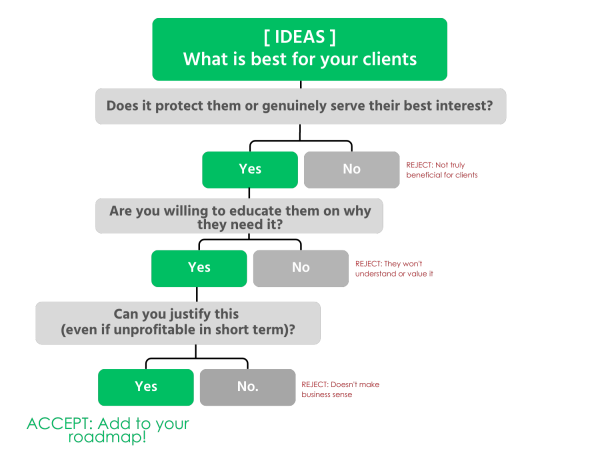
Sometimes you need to be your client’s advocate.
Even their protector.
That means offering something they may not yet realize they need, but that is genuinely in their best interest.
You’ll have to educate them, and then finally then let them decide.
Last year, we rolled out Termageddon for privacy policies and cookie compliance to protect clients from real legal risk.
Did we make money on it?
Probably not.
Between setup, meetings, and implementation, we likely lost money.
But it was the right thing to do.
And protecting our clients mattered more.
Looking ahead to 2026, we’re looking at rolling out Accessibility services.
This is critical.
I personally know a business that was sued for $75,000. They had to pay the plaintiff and still make the required changes to their website.
So ask yourself: What is truly best for your clients, even if it’s uncomfortable to bring up?
(3) Maximize your strengths
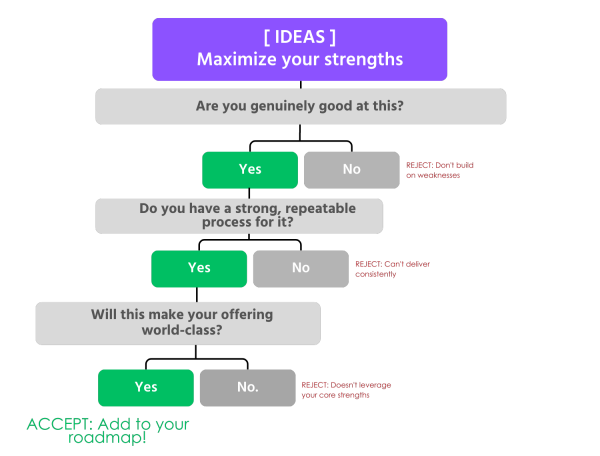
This is where you double down.
Ask yourself:
If nothing were too hard, too expensive, or too time-consuming, what would make our offering world class?
Don’t dismiss ideas too early, as there’s time for that later.
A few months ago, we made the decision to mandate that we handle the core content creation for websites we build.
Why?
Because we are really good at it.
We have a strong process to uncover:
- What a company does
- Their values
- Their differentiators
- Their calls to action
And we turn that into clear, compelling website content.
Our clients love it.
Recent examples include:
- Sow & Reap
- Dialed In Staffing
- Patrick Kamba
This approach makes life easier for us, easier for our clients, and produces faster results.
That’s what maximizing strengths looks like.
(4) Minimize your weaknesses
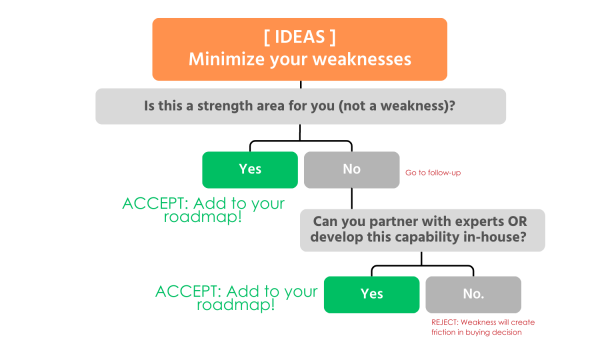
This is usually the hardest part.
There’s a reason you’re weak in certain areas; if it were easy, you’d already be great at it.
A practical strategy:
- Refer clients to trusted experts across multiple budget ranges
- Over time, decide which services are worth developing internally
That’s exactly what we’ll be doing more intentionally in the coming year.
Thus, the goal isn’t to be great at everything.
It’s to remove friction from the buying decision so your weaknesses don’t become reasons someone hesitates or walks away.
Conclusion
Even without a formal Competitive Set Analysis, this framework can guide your planning:
- Yearly
- Quarterly
- Monthly
- Or even weekly
And it works.
If you’d like help doing a Competitive Set Analysis, we’d be happy to help.
We’re actively going through this process ourselves.
And it matters.
Want help applying this to your business?
If you’d like help doing a Competitive Set Analysis, or walking through this framework with your specific business in mind, we can help.
We’ll look at:
- Your website and online presence
- What your competitors are doing well
- Where you’re already strong
- Where small changes could make a big difference
No pressure. No obligation.
Just clarity and a clear path forward.
Remember, winning online isn’t about doing everything. It’s about doing the right things, on purpose.