


Will AI replace your job? Or even your company?
The reality is that almost every job is going to be touched by it. Even the mechanic's.
When a headlight went out on my car, I popped the hood and found a mess of connectors. I had a general idea which one to unplug, but not specific, and it's not easy to unplug some of those connectors! So I asked AI. It walked me through part of it, and I fixed it myself. Normally, that's a call to somebody.
While that's a small example, multiply it across every trade and every profession, and you can see where this goes. People will ask AI to show them how before they call anyone. The work left for the pro moves toward the harder problems. Toward the skills AI can't replace.
That's not a reason to be afraid. It's a reason to use AI to do what we do better and faster, and to get clear on which part of the work stays ours.
Dan Martell recently put out a video called Stop Doing The Work AI Will Replace, Learn These 10 Skills Instead. I played it for my team at our weekly meeting. Kenneth's reaction stuck with me: These aren't new skills - the AI era just enforces them harder.
I agree with most of Dan Martell's 10 skills. Five of them I'd frame differently. Here's my take on all ten.
If you only remember five, remember NO COAST: Never Outsource Care, Own, Ask, Sell, and Trust. Those are the ones you never hand to AI.
1. Show
First up: turning complex ideas into a picture. Martell's right on this one.
We have to start thinking in pictures, not just words. I use flowcharts and diagrams that move from one state to the next. With my team, I've drawn out the funnel we use for selling more than once, on my iPad or on a piece of paper, boxing it out until everyone sees it the same way.
AI can help you practice this. But you have to start thinking that way first.
Because when people can see it, they can understand it, and then they can do it.
2. Sell
Martell frames selling as getting a yes from another person.
I'd push back on that. A yes isn't the goal. A yes from someone who agrees your solution is what they need is the goal. You don't want to sell somebody something they don't need or want.
Sell with integrity, and use AI to help you plan it. I have an AI sales coach that keeps the lessons from every sales conversation I have. Before the next call, it reminds me of what I learned on the last one and what will apply to this one.
The other half of selling is proof. Case studies take time. You need the before, the during, and the after, with real numbers. That's exactly why they're hard for AI to copy.
So you need the RIGHT yes from someone, and you really need to back it with proof.
3. Taste
Taste is knowing what looks good, sounds good, and feels good. Martell says you build it by studying the greats, and he's right.
Whatever your profession, you need to know what lands with another human being. That's how you keep AI help from turning into slop anybody could make.
It has happened to us several times. Recently AI built a button for us from an HTML file. It left out the hover states. It left out the icon. It looked done, but it wasn't. Someone with taste had to catch it.
Taste is what turns AI-drafted output into something human.
4. Ask
A bad question gets a bad answer. That's Martell's point, and AI works exactly the same way.
I'd add one thing. Frame the outcome, too.
That's one of the keys to writing better AI prompts. Ask AI questions, or have it ask you questions, but tell it what done looks like: who it's for, what they should understand when they finish, and what they should do next.
A good question finds the problem. Telling AI what done looks like is how you actually get it solved.
5. Trust
Martell says the future belongs to the people with the largest reach and the best reputation.
Reach isn't trust. Plenty of people have a big audience and nobody trusts them.
Raymond Aaron's branding ladder explains the difference. From the bottom up:
- Absence. They don't know you exist.
- Awareness. They know you. That's it.
- Preference. They'd pick you if it's convenient.
- Insistence. They want you even if you cost more or they have to wait.
- Advocacy. They bring their friends.
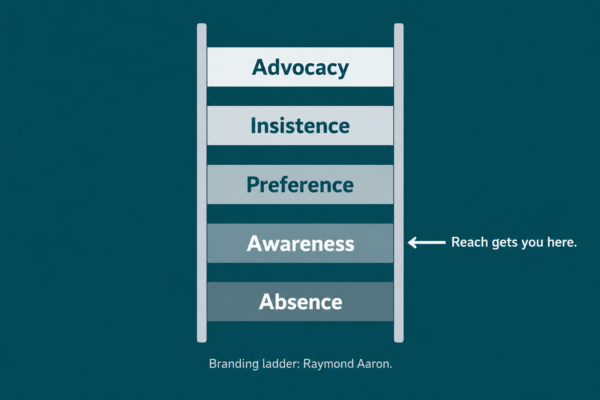
Reach gets you awareness. That's the second rung of five.
Climbing takes something else. As Aaron puts it, the job starts when the transaction is over.
We've had clients ask us to build things we don't even offer. Not because it's on our menu, but because they trust us to do it well. That's insistence. You can't buy that with reach.
Be the one they insist on.
6. Own
This one is accountability. AI has no skin in the game. When it makes a mistake, who do you blame?
Here's one of ours. Recently a routine plugin update on a client's site clashed with another plugin. The forms still looked fine. But any message that included a checkbox or a radio button failed before it saved. No entry. No notification. We found it two days later, while testing something else.
Six messages were lost.
We fixed it that day. Then we told the client everything: what broke, for how long, and the exact times of the six lost messages, so their team would know why if someone called saying they never heard back. And we added a check to the test we run after every plugin update, so it doesn't slip through the same way again.
AI wasn't going to own that conversation with the client. We did.
7. Story
Storytelling has mattered since the paintings on cave walls. It matters more now.
Martell says the person who tells the best story wins. Work on your stories. Collect examples. Keep your cases, because they become the memorable moments you use to connect with people and make your point.
Which brings it back to case studies. They're stories with real, tangible outcomes.
8. Care
You can't fake care. Martell puts it this way: empathy can't be simulated.
We want to be partners with our clients, not vendors. We don't just want to build a website or do SEO. We want their company to succeed.
Some of my best client meetings have nothing to do with websites. We talk about building a CRM inside their company, leadership principles, or how to sell their vision to their own team.
9. Lead
Martell says leaders are the people who make people move. Nobody follows a machine off a cliff.
I see it differently. Leadership isn't making people move. It's:
- Freeing people to do what they do best
- Holding them accountable
- Giving them a scorecard and letting them go
That last one is where I need to get better. My team should have scorecards so they know where they stand without waiting on me. I'm putting it in writing here so you can hold me to it (that's Own in action for me).
Free them. Then measure.
10. Connect
Martell's version of connect is being the bridge. Introduce people to the people who can solve their problems. Intros run on trust, not data. I like that.
My version is a little different. Connect with people yourself, using your own strengths. Maybe that's one-on-one. Maybe it's one-on-many. Virtual calls are great, but nothing replaces showing up in person.
About a year ago, I flew across the country at my own expense to meet a client. My wife and I built some vacation around it, but we made the time. They told me people just don't come visit them. Our relationship has never been the same since.
Both versions work. Do both.
How Are You Doing?
Ten skills. You're probably strong in a few. A couple of them may have made you wince.
If ten is too many, start with NO COAST: care, own, ask, sell, and trust. Pick one of the five to work on this month.
If trust is on your list, start with how people find you. More of them are asking AI before they ever reach your website. Get your free AI Visibility Report and see whether AI platforms recommend you, or someone else.